Spanish (page 7)
Beginners’ Spanish I (SPAN 201): Researching Historical & Cultural Locations of a Country of Interest
Amanda Leung
I am travelling to Chile this December and am researching historical and culturally relevant locations to visit. I came across the Atacama desert in northern Chile (Norte y Desierto de Atacama). This portfolio focuses on the Atacama Desert, and how I understood the information from websites in English versus Spanish. It will also focus on the history and culture of the Atacameña people who are the indigenous inhabitants of this region.
San Pedro de Atacama is located in the Atacama Desert, it is a small village with very few amenities. I plan to fly into this village so I can explore the rest of the Atacama Desert. The Atacama is the driest desert in the world, extending across northern Chile, with parts in Peru and Bolivia (Museo Chileno De Art Precolombino, n.d.). At 4,000 m above sea level, the desert is characterised by its aridity and unique geological formations (Chile Travel, 2021). One formation includes the Death Valley, which features red rock landscapes and high concentrations of salt and lithium. Despite its harsh environment, the Atacama Desert has been continuously inhabited for over 11,000 years, making it an important historical region within the country (Johanson, 2022). It is a very thin desert, which sits between the Pacific ocean and the Andes mountains (Johanson, 2022).
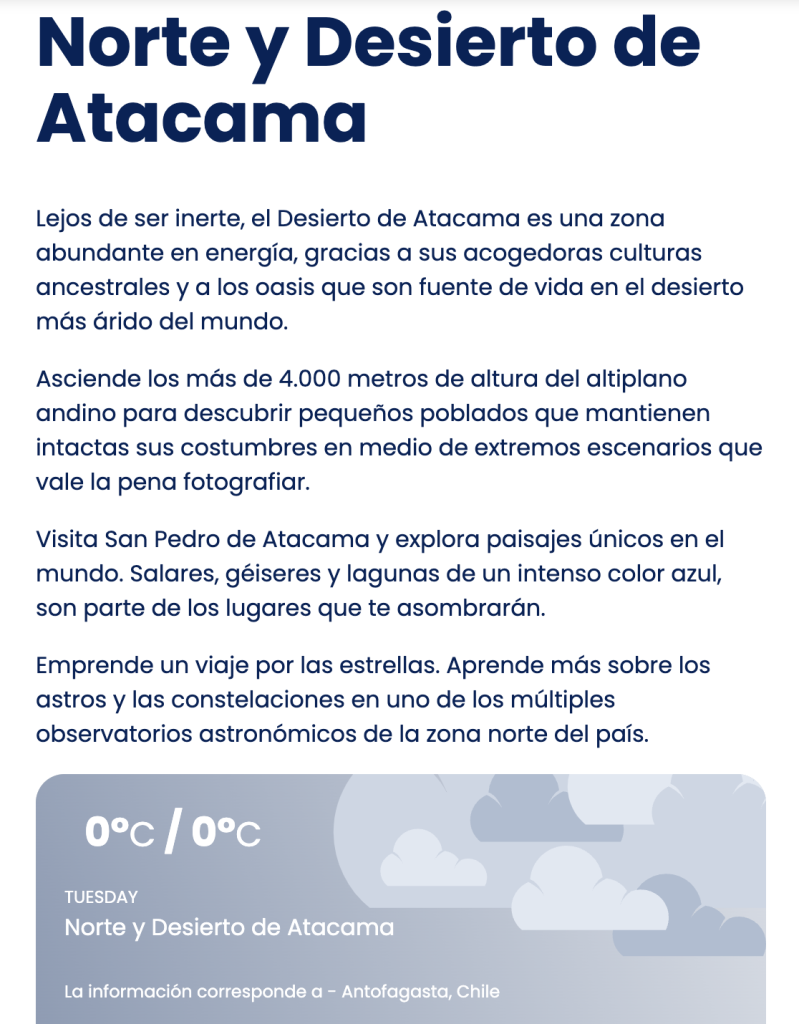
While I was researching this topic, I came across the official Travel Chile website where there was a spanish and english option. I read the website in Spanish first, then in English to see how much I could understand. An image of the passage taken directly from the website below:
It was useful to understand the context of the website- it serves to provide knowledge for
tourists and those interested in the region. Using this, I found many sentences containing
cognates such as “una zona abundante en energía”, “culturas ancestrales”, “géiseres y lagunas de un intenso color azul,”, “Visita… y explora”. These provided understanding that this is an important place for cultural history and contains geysers and very blue lagunas. I learned a few words in SPAN 201 which assisted with my learning including “aprender”, “viajar” ,and “pais” which added context to the passage. I also noticed that the number four thousand contained a period instead of a comma (4.000 vs 4,000), which I had previously learned in SPAN 201. Overall, I understood that the website was discussing the beauty of the desert. It was difficult to translate my understanding of basic vocabulary and recognizing cognates to interpreting a sentence.
For example, in the sentence “Lejos de ser inerte, el Desierto de Atacama es una zona abundante en energía, gracias a sus acogedoras culturas ancestrales y a los oasis que son fuente de vida en el desierto más árido del mundo.” I could understand that the desert was described as an abundance of energy and cultural ancestry and that it is the driest desert in the world, however, I cannot understand any further. The sentence “que son fuente de vida” is difficult to interpret, because I have not learned what “fuente” means and I do not fully understand the use of “que” or “son” in this context. Additionally, the sentence “son parte de los lugares que te asombrarán.” seems out of my knowledge of sentence structure of what I would learn in SPAN 201. Once I translated the website to English I was able to fully understand the contents of the website. Based on my observations of this activity, I think that SPAN 201 has familiarised me with common words and phrases I will find in Spanish. We haven’t gone over extreme conversational Spanish or sentence structure and grammar, but we may in the future, or another class like SPAN 203 will cover this.
Additionally, as part of the portfolio, I looked into the Atacameña people, also known as Atacameños, who were the original settlers of this region. I believe that if I am visiting a region, I should be aware of its cultural heritage and history. I attempted to read some information in Spanish, but I found the sentence structure far too complex. The paragraphs were written in the past tense, making it difficult to understand. I attempted to read information from this website. In this sentence” Los atacameños, atacamas o licanantay, que en su lengua querría decir ‘los habitantes del territorio’… cuyos antedecentes se pueden seguir al menos hasta 1500 años atrás.” I could not understand the use of “querría decir” or “cuyos antedecentes se pueden “. The use of “se” and “pueden” seems to mean “to take from them”, but I am unsure of its meaning in the context of “cuyos antedecentes”. Resultantly, I will use the next paragraphs to understand the Atacameños history and compare it to Indigenous Peoples in Canada.
When the Atacameños first arrived, the climate was more humid, supporting agriculture such as maize and beans (Cascada Team, 2021). By 900 BC, llama-herding villages developed, and the Atacameña culture was influenced by the Tiwanaku and later the Inca Empire (Cascada Team, 2021). Spanish colonisation in the 16th century and the War of the Pacific (1879–1884) heavily impacted the region. The desert was geographically divided between Chile, Peru, and Bolivia, and the Atacameños were forced to choose a country to reside in (Museo Chileno De Arte Precolombino, n.d.).
Atacameña spiritual beliefs were deeply rooted in their connection to the land. Their worldview, similar to the Incas, sees the landscape as alive, with hills and waterways inhabited by spirits. One important ritual is the “limpia de canales,” where community members clean irrigation canals in honour of these spirits. Although the Atacameña are now legally recognized as one of Chile’s nine indigenous groups, their ancestral lands are still state-owned, conflicting with their traditional worldview that considers the land sacred.
Comparing the Atacama culture to Indigenous cultures in Canada, such as the Metis nation in Treaty 7 Territory of Southern Alberta. Both cultures adapted to harsh environments—Atacama’s desert and Alberta’s prairie—while developing rich artistic traditions and social structures. The Atacama’s reliance on llama herding is similar to the Metis’use of bison, highlighting a deep connection to the land. During colonisation, Spanish dominion led to forced cultural assimilation, similar to the English and French impacts in Canada. While the Atacama integrated aspects of Catholicism into their beliefs, many Indigenous groups in Canada fought harder to retain their traditions. One similarity between the two groups is that the Spanish and English both forced indigenous groups to give up their land and created random borders in the land for each country. This went against the indigenous groups values in land.
References
Cascada Team. (2021, June 16). The atacameños: People of the desert. Patagonia Tours Travel, Chile, Argentina, Torres del Paine, Hiking – Cascada Expediciones. https://www.cascada.travel/blog/the-atacamenos-people-of-the-desert
Chile Travel. (2021, August 25). Norte y Desierto de Atacama. https://www.chile.travel/donde-ir/macrozona/norte-y-desierto-de-atacama/
Johanson, M. (2022, January 5). A first-timer’s guide to chile’s atacama desert. Lonely Planet. https://www.lonelyplanet.com/articles/first-time-in-atacama-desert
Museo Chileno De Arte Precolombino. (n.d.). Native peoples > Atacameños. Chile Precolombino. https://chileprecolombino.cl/en/pueblos-originarios/atacamenos/historia/
SanPredroAtacama. (n.d.) Useful information. SAN PEDRO DE ATACAMA. https://sanpedroatacama.com/en/destination/useful-information/