Arabic (page 4)
Intermediate Arabic I (ALMC 331): Watching a Documentary
John M.
In one of my last cultural portfolios, I watched an Arabic documentary and listed down words I recognized. Although it was a difficult activity, it was quite engaging. For this portfolio, I wanted to do something similar while exploring a different type of video content; therefore I searched for videos on Playaling.com and found a whimsical educational video on the linguistics of Arabic languages and dialects. I watched the 24-minute video through YouTube and used Playaling’s Arabic transcription and English translation to focus on the dialect section (10:26 – 15:26) of the video.
In Playaling, I filtered the results by intermediate difficulty and Modern Standard Arabic (MSA) and found a video titled ‘لماذا تختلف لغاتنا و لهجاتنا ؟’. I inferred from لماذا (why), لغاتنا (our languages), and the context of the video that the title meant ‘Why are our languages and dialects different’. When I first watched the video, there were many sentences and phrases that I understood right away such as في كل لغة حروف أصعب من (In every language, there are difficult letters than…), where I recognized the comparative أصعب من. Also, I noticed he used يعني (which means), which was part of our recent vocabulary, as a filler word. When describing where letters are pronounced in the throat, he used يخرج (to go out), which was unexpected because I associate the word with living people rather than ideas such as letters.
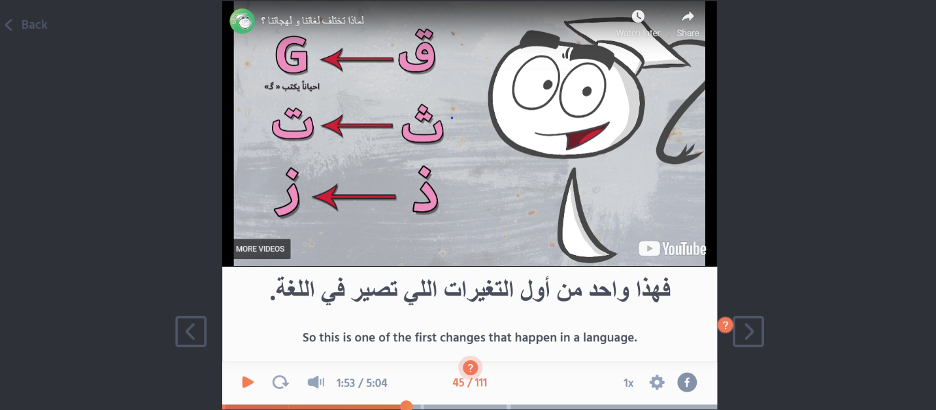
In the dialect section of the clip, he gave examples of letters in the Arabic language (في اللغة العربية مثلا) which can be difficult to pronounce and how certain regions transform the letters to make pronunciation easier. The first example was the sound ق (qa) to ج (ga) in Gulf countries like Iraq and Sudan (دول الخليج والعراق و بعض مناطق والسودان). In their dialect, many words (الكثير من الكلمات) such as قلب (heart) became جلب. On the other hand, Egypt and Levantine countries changed their (مناطق أخرى مثل مصر ودول الشام), ق (qa) sound to a hamza (أ) and so قلب would turn into ألب. Other examples include the change of tha (ث) to ta (ت) in كثير (كتير) and the change of zal (ذ) to za(ز) in أستاذ(أستاز). The speaker’s favorite (المفضلة) transformation involves ك (kaf) with a kasra which can change to a ch (چ) or a ts (تس). For instance, ‘for you’ (لك) can be pronounced as لتس or لچ. Apparently, this change is very old (قديم جدا) as you can find it in early Islamic poems. I found these changes fascinating because I see the same phenomenon happen in Filipino, where letters like V become B as it is easier to pronounce in a Filipino conversation.
Another type of transformation is the assimilation of letters (أحيانا الحروف تاكل بعضها), which is a result of people shortening words or phrases for everyday conversations. A good example would be that/which (إلّي) which is feature of many dialects. Originating from الذي (masculine) and التي(feminine), the letter after lam (ل) is ‘eaten’ which leaves إلّي. Additionally, the combination of أي (which) and شي (something) into أيش (what) caught my attention because I used to wonder why the MSA word for what (ماذا) was different in dialect. Other similar transformations include رصصت (I packed) to رصيت, where sad(ص) was changed to ya(ي). He further explained that these changes do not lead to the disappearance of a language, but rather it creates new words (كلمات جديدة). In this section, he used the negation particle for the past (ما) and the linking verb أن (that) for sentence complements (تقول إن الكلمات), both of which were part of our ALMC301 lessons.
Overall, I really enjoyed studying the video using Playaling as it had features such as transcripts, speed adjustments, section replaying, and definitions. The video delivered dense material regarding dialects in a fun way, and I could not stop watching. It was a great listening and comprehension exercise, and I am slowly getting used to the speed of regular conversations in Arabic. My father used to tell me he could tell where people are from based on how they pronounce a letter. I understand now that these differences have meaningful origins, and they contribute to the richness of Arabic culture and language.
References